Showing posts with label communication. Show all posts

Thursday, July 14, 2011

Group Work is Rewarding?


In library school they always made us do a ton of group work in a slightly desperate attempt to teach us how to collaborate. This will mimic the real world, they said. Once you get your job, you’ll have to collaborate with your co-workers on projects. Why not start that now?

Well, for the most part, they were right, but for some reason “group work” seems even worse in the workforce than it did in grad school. I think that group work in grad school is tolerable because there is a pretty good chance you’ll get at least one team member who is on the ball. Also, the group work suffering ends at an appointed time (i.e. the end of the semester), so the diligent students feel free to work harder on their projects because there is an end in sight.

Reasons I am thinking about this: my library is currently in the middle of a massive shifting project. (At least it feels massive. There are only 2 floors to my library, so it’s not as bad as it could be.) In the midst of this project, the rest of the librarians realize that the library has NEVER been weeded. Ever. Since its inception. Cue massive weeding project. And now we arrive at my group work frustration.

Once everyone realized that project (i.e. the cataloger) participants were not pleased with the direction of the project, we had a big brainstorm group meeting to communicate our goals and plans accurately to each other (which should have happened in the beginning). Communication is not a strong point of my library, primarily because most of the employees have been there a while and understand how operations are supposed to work. We all collectively decided in this meeting that we would weed certain areas per our subject “specialties”, write the faculty for approval, and then remove the books. Weeding is a collaborative process: librarians, the cataloger, and faculty are all involved. Our workflow is

Librarian analyzes / weeds books >> Faculty approve or disapprove selections >> Books go to the cataloger for removal and disposal

The workflow works pretty well, except for the fact that it is a funnel: there are multiple librarians and faculty and one cataloger (who refuses to ask for help). Furthermore, the cataloger feels that it is her job to re-evaluate our weeds. I can’t quite figure out what bothers me about this. Is it because my authority and experience is questioned? Is it because this slows the process down immensely as our cataloger spends 5 minutes on every book? Is it because I feel that she is an interfering busybody? Is it her tone when she questions my weeds? I don’t know. I also realize that her input is important because she has been at the library so long, and she knows the collection really well. She doesn’t really have a firm grasp on how students use our resources, but she knows what books we have, why we have them, where they came from, what courses they support, and so on.

My boss has stressed over and over how weeding is a collaborative process. My boss doesn’t want to get involved in what I am sure she views as territorial scuffles. Meanwhile, the other librarians and I are getting very frustrated. In group work, everyone has a part of the project to complete. If someone doesn’t do their part, the other group members pick up the slack. Currently, we are all doing our work, so there is no need for others to pick up the slack. There is also a person at the end of the project who makes sure that everything is cohesive. It just burns my biscuit that the cataloger is that end of project person, and she doesn’t seem to share the same vision of an academic library as the librarians.

Tuesday, December 14, 2010

Good Customer Service: A Twitter Odyssey

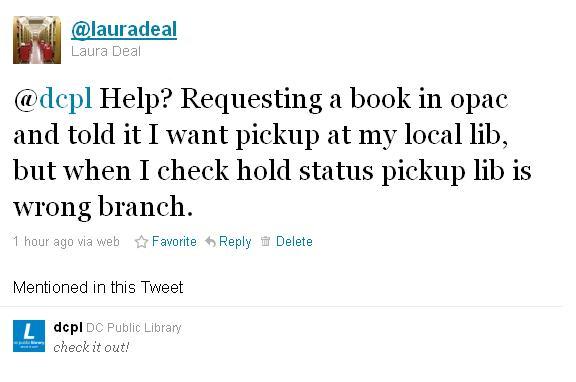
I'm still thinking about my institution's social media strategy and wanted to share a positive story about another organization that's Doing It Right. I recently signed up for a DC Public Library card. I tweeted about it, including an @ mention for the system's Twitter account @dcpl.


@dcpl quickly retweeted my message and replied:


I thought that was great, a quick acknowledgment of positive feedback and a reminder about what I needed to do next. Plus, an invitation to move from the internet world into the real world to interact more.

I placed a hold with my new temporary card number and went to my local DC branch a few days later to get my official library card. Side note--DCPL gives you a choice of different card designs, which I also loved. I got the one with the frog that says "Hop into Your Library."

All well and good, until today I noticed a problem. When I looked up that hold I placed earlier, the wrong branch was listed as the "Pickup Library." My book was apparently being shipped to a library across town that would take me over an hour to get to!

Normally in this situation I would search out the customer service number/email and contact the library that way. But, instead I thought, "hey, I know they check their Twitter account regularly, maybe that will be faster."


Within minutes, @dcpl added me as a follower and sent me a series of direct messages. The staff member on the other end looked up my library account and figured out that the problem was just a bug in their new online catalog software. S/he alerted their IT department and assured me that my book would be delivered to the correct branch. S/he also suggested that I change my pickup branch since my local library is going to be temporarily closed in a few weeks. (It's moving to a new building! Very exciting!)

All and all, a great service experience. Quick response, helped me solve my problem, and also helped me avoid another problem I didn't even know I had.

To follow up, I asked how DCPL manages their Twitter account, and got the answer "A few dcpl staff run the twitter collectively - from branch managers to library associates to marketing staff."

Lessons I'm Taking From This:
  1. Good customer service online is just like good customer service offline. It means being friendly, responding quickly, and solving problems.
  2. Responding to casual messages makes people much more likely to communicate with you in the future. If @dcpl hadn't responded to my first @ mention, I doubt I would have tried asking for help through Twitter. I would have assumed that they don't check their @ replies, as most institutions (like mine!) do not.
  3. If you make it apparent that you are available, people will send you questions, so you'd better be prepared to answer them. If you don't have time, you probably shouldn't be on Twitter in the first place.
  4. Empower staff to respond to questions and solve problems via Twitter.
  5. Have many people involved to lighten the burden and ensure good coverage. Alternately, one dedicated person with plenty of time or several people with set shifts could work.

Wednesday, November 10, 2010

D'oh

I'm not sure to what extent we are truly wanting to delve into our jobs here, but I thought I'd share a truly humbling experience I had at work today.

There are three or so main areas I supervise. They all have great people on their teams and have obviously been doing just fine without me. However, there is always room for improvement, and I often play the role of conduit between upper administration and various departments.

In my eagerness to help "fix" things, I didn't realize I was actually muddying things up and inadvertently stepping on toes. One of my employees - Jane Doe - asked to speak with me today and point blank asked me who, exactly, is supervising her department. Is it her or is it me? I had spoken with one of Jane's team members yesterday about some changes I was thinking about making, and then she told Jane (innocently, I think) about them; Jane got upset that I was confusing her employees and not communicating clearly with her at all stages of the change making process.

It was one of those moments where I was utterly caught off guard because I had no idea I was causing problems. I saw an issue and wanted to fix it. But I could also see Jane's perspective because she has a system that has been working for literally decades and there is still a lot I don't know.

I apologized to Jane and there were no hard feelings. Yes, I feel a little awkward, but that will have to pass because I am an adult and she wasn't doing anything out of spite. I appreciated her coming to me before she got really upset and I am pleased with myself that my employees know they can approach me to work through challenges.

So, what are the lessons I learned today?
  1. Even if you have nothing but good intentions, something can (and probably will) throw you off guard when you least expect it.
  2. Honest communication is absolutely amazing.
  3. Your work will always find opportunities to humble you so that you can grow from it. These small instances hone your instincts (and will allow you to have your day in the sun someday, too).
  4. While we solved the current issue, this allowed me to pinpoint more of my weaknesses AND my workers'. I am often overly gung ho and trip over my feet like a puppy. My team members have been doing this a long time and can be territorial and slow to change. Neither of us is wrong, but rather we have rough edges to work on. 
  5. As a leader - and you're a leader no matter your position on the totem pole - you set the tone for how problems get solved. Empathy, patience, active listening and humility are the keys to survival. It's just as bad to fly off the handle as it is to cry as it is to shut down (and the list goes on).
  6. People talk, both innocently and maliciously. Plan how you unveil ideas carefully, even if it makes you feel crazy or paranoid.
  7. Be the bigger person. Choose your battles and get over the idea of being a martyr. You should do what is right simply because it is right and nice guys and gals often (always?) finish last. I'm getting pretty comfortable under the bus.
I hope this post isn't obnoxious and I'm sorry if it is. This situation is interesting because there are so many facets - chain of command, opinions on workflow, age differences and new versus old. I'm a fool if I expect everything to be as solved as calmly as this but my organization is a fool to think I'm not going to implement some changes. I hate the idea of people being unhappy, but my greater allegiance is to the ideals of librarianship and service and NOT my personal comfort.

What was I thinking when I went into administration?!

Friday, November 5, 2010

someone call Zuckerberg

Does anyone have any great ideas for a Facebook contest? My library's FB page just reached 800 fans or "like"-ers or whatever they're called, and in my overwhelming joy and sheer exhileration, I rashly promised that when we get near 1,000, we'll have a contest that includes prizes.

We've been talking about a FB contest at work for a while, but the ideas never get beyond vague things about library trivia and favorite books and virtual scavenger hunts mumble mumble. Even though I really do believe FB is a good (the best?) communication tool with a few of our audiences, especially undergrads, I am kind of sick of it personally and not coming up with much. Ideas?